Learning to look
Art
Learning to look.
This space is for learning, not teaching. I share artists, ideas, and works that move me, people like Toulouse-Lautrec, and what I discover as I spend time with their art. It’s an ongoing conversation with beauty, history, and human expression.

Jacques-Louis David
Five works on conviction, duty, power, and the courage to see differently.
01 / JACQUES-LOUIS DAVID
The Death of Socrates
David depicts the final moments of Socrates, condemned by Athens and choosing death rather than abandoning his principles. The philosopher reaches calmly for the cup of hemlock while continuing to teach, his raised finger directing attention beyond the physical world.
The emotional contrast gives the painting its force. Socrates remains composed while the people around him collapse into grief, disbelief and resignation. David turns an ancient death into a meditation on conviction: what happens when a person values principle more than survival. The Metropolitan Museum notes that Plato, seated at the foot of the bed, was not actually present at Socrates’s death, but appears as the author who preserved the event in the Phaedo.
Reference points: Socrates · Plato · hemlock · immortality of the soul · moral conviction · sacrifice
Interpretation: The Metropolitan Museum of Art, collection commentary ↗
Collection: The Metropolitan Museum of Art, New York · Catharine Lorillard Wolfe Collection, Wolfe Fund, 1931.
Image: The Metropolitan Museum of Art. Public domain.
02 / JACQUES-LOUIS DAVID
The Oath of the Horatii
Three Roman brothers extend their arms toward their father, who holds the swords with which they will defend Rome. David invented the oath itself rather than simply illustrating a passage from antiquity, transforming the scene into a concentrated image of duty, discipline and sacrifice.
The composition is deliberately divided. On the left, the men are rigid, geometric and resolved. On the right, the women fold into one another in grief. Public obligation and private emotion occupy the same room, but almost different worlds. That tension is what makes the painting more than a patriotic image: duty has consequences, and someone always bears them.
Reference points: Roman virtue · duty versus emotion · sacrifice · family · patriotism · Neoclassicism
Interpretation: Musée du Louvre, Jacques-Louis David educational dossier ↗
Collection: Musée du Louvre, Paris · Department of Paintings · INV 3692. The monumental canvas measures approximately 330 × 425 cm. Museum record ↗
Public-domain artwork.
03 / JACQUES-LOUIS DAVID
Napoleon Crossing the Alps
This is not documentary realism. It is image-making.
David shows Bonaparte on a rearing horse, his cloak lifted by the wind and his arm pointing forward. On the rocks beneath him appear the names BONAPARTE, HANNIBAL and KAROLUS MAGNUS, linking Napoleon visually with Hannibal and Charlemagne. The Louvre describes the painting as deliberately transforming Bonaparte into a legendary, almost providential leader.
The real power of the painting lies in that transformation. David takes political authority and gives it the vocabulary of myth: elevation, movement, control and destiny. It is both portraiture and political communication.
Reference points: Napoleon Bonaparte · propaganda · heroic portraiture · Hannibal · Charlemagne · political mythology
Interpretation: Musée du Louvre, Jacques-Louis David exhibition commentary ↗
Collection: This version is held by the Musée National des Châteaux de Malmaison et de Bois-Préau, Rueil-Malmaison. David ultimately produced five versions of the composition.
Public-domain reproduction via Wikimedia Commons. Image credit ↗
04 / JACQUES-LOUIS DAVID
Portrait of Madame Récamier
Juliette Récamier reclines on a long classical daybed in an almost empty room, dressed in white and surrounded by remarkably little ornament. David strips the portrait down to posture, silhouette, fabric and space.
The apparent simplicity is deceptive. Madame Récamier was one of the celebrated figures of Parisian society, yet David avoids the conventional display of wealth associated with elite portraiture. The antique-inspired furniture and dress turn her into something almost timeless.
The painting was never finished. It was begun in 1800 but left incomplete later that year after a rupture between David and his sitter, and it remained in the artist's possession until his death.
That incompleteness is part of its modern beauty. The empty background creates a psychological distance between the sitter and the viewer.
Reference points: Juliette Récamier · Directoire society · classical simplicity · elegance · unfinished painting · negative space
Interpretation: Musée du Louvre, collection and Jacques-Louis David exhibition commentary ↗
Collection: Musée du Louvre, Paris · Department of Paintings. Oil on canvas, approximately 174 × 244 cm.
Public-domain artwork.
05 / JACQUES-LOUIS DAVID
The Intervention of the Sabine Women
David chooses an unusual moment from the Roman legend. He does not show the abduction of the Sabine women. Instead, he shows the moment when the women intervene to stop the war between their Roman husbands and their Sabine fathers and brothers.
At the center is Hersilia, placing herself physically between Romulus and Tatius. Her body becomes the barrier between two armies. Around her, children, mothers, soldiers and horses turn the battlefield into a scene of emotional and political confusion.
David began developing the work after the fall of Robespierre, during a period in which he himself had been imprisoned. The Louvre interprets the finished painting as a call for reconciliation after the divisions and violence of the French Revolution.
That context changes the painting. It is not simply about ancient Rome. It asks whether courage can mean stopping a conflict rather than winning one.
Reference points: Hersilia · Romulus · Tatius · reconciliation · civil conflict · women as peacemakers · French Revolution
Interpretation: Musée du Louvre, Jacques-Louis David exhibition commentary ↗
Collection: Musée du Louvre, Paris · Department of Paintings · 1799 · oil on canvas · approximately 385 × 522 cm. Museum record ↗
Public-domain artwork.
Henri de Toulouse-Lautrec
Seven works, from the spectacle of Parisian nightlife to quieter moments behind the scenes.
The reading notes below paraphrase the credited museum, scholarly, and catalogue sources. Follow each source for its full interpretation. Image credits appear beneath each work.
01 / HENRI DE TOULOUSE-LAUTREC
Rousse (La Toilette)
The Musée d’Orsay connects the high viewpoint and unposed figure to Degas’s scenes of women washing. Lautrec brings us close to an ordinary private moment, with the woman’s back anchoring the composition. The museum distinguishes his approach through the humanity of his observation. The room’s wicker chairs also suggest his own studio as the setting.
Interpretation: Musée d’Orsay, collection commentary via Google Arts & Culture ↗
Musée d’Orsay, Paris. Photograph: Didier Descouens, via Wikimedia Commons; resized site reproduction. Image source ↗ · CC BY-SA 4.0 ↗
02 / HENRI DE TOULOUSE-LAUTREC
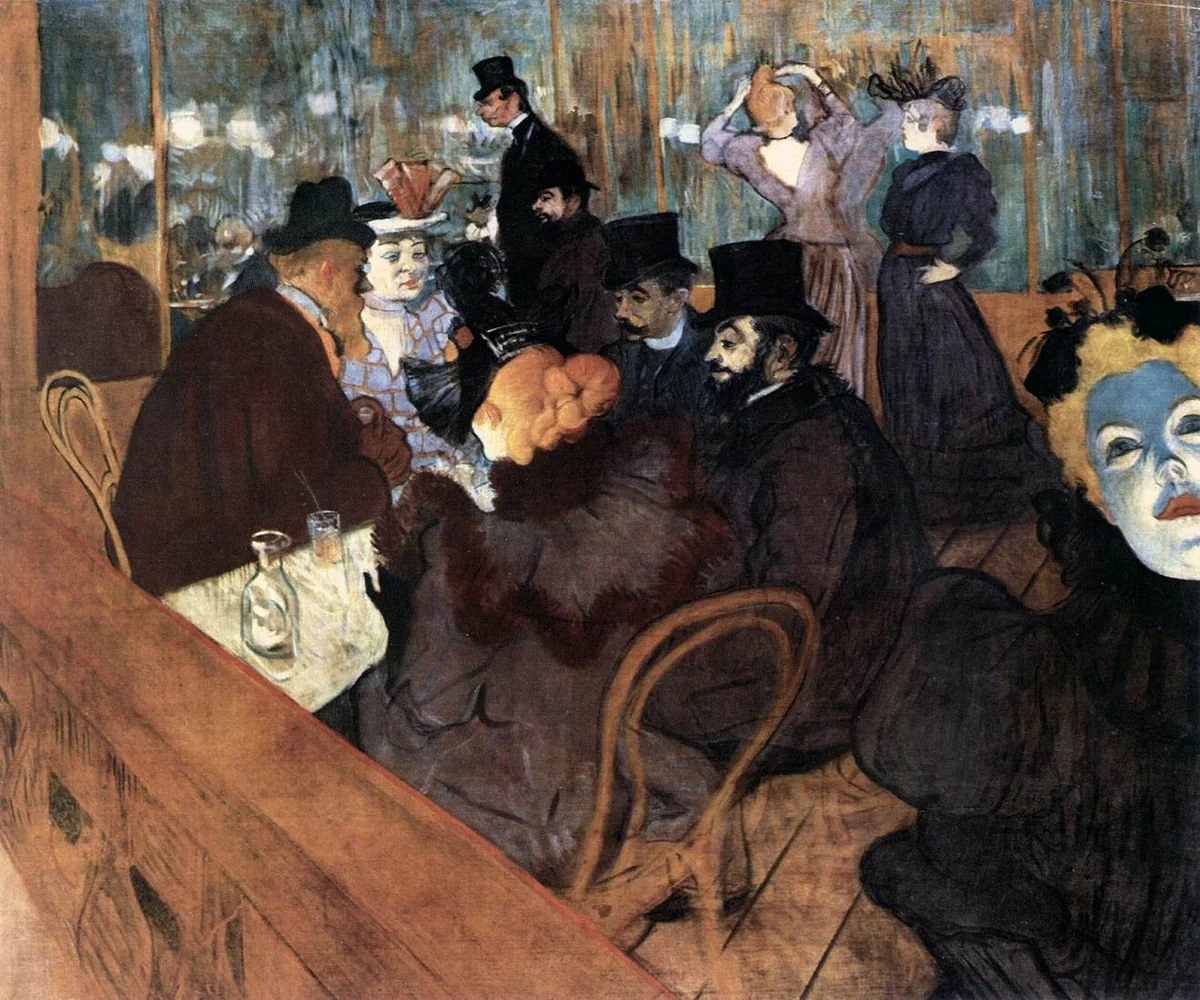
At the Moulin Rouge
The Art Institute of Chicago identifies this as a group portrait of Lautrec’s own circle. The dancers Jane Avril and La Macarona sit with his friends; Lautrec appears in the background beside his taller cousin. At the right, May Milton’s startling green face shows his fascination with the nightclub’s electric lighting. Artificial glare becomes part of the painting’s expressive language.
Interpretation: Art Institute of Chicago, collection commentary ↗
Art Institute of Chicago, Helen Birch Bartlett Memorial Collection. Public-domain artwork. Image source ↗
03 / HENRI DE TOULOUSE-LAUTREC
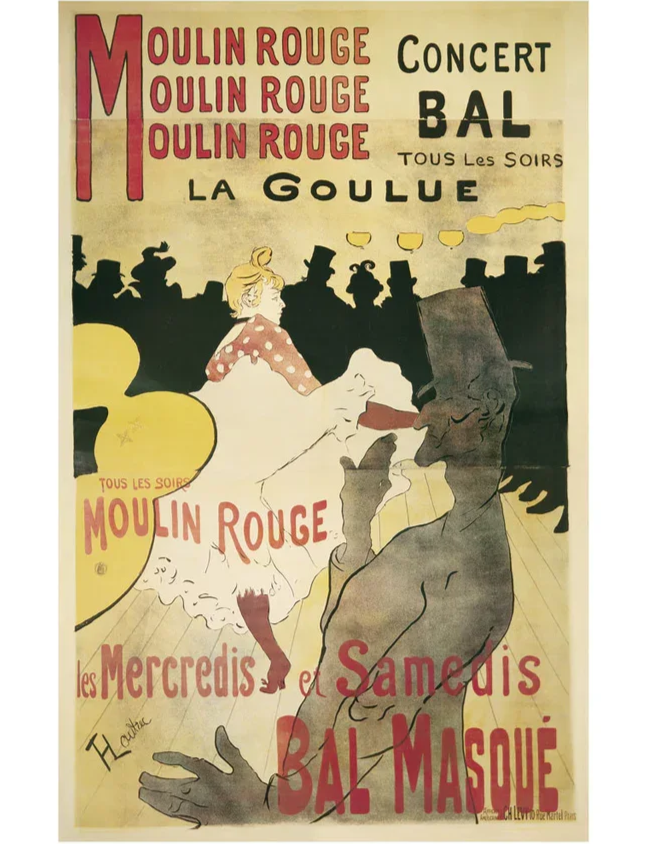
Moulin Rouge: La Goulue
The Metropolitan Museum of Art describes this commission as the breakthrough that launched Lautrec’s career as a poster designer. It directs attention to the Moulin Rouge’s star performers: La Goulue and Valentin le Désossé. Their distinctive shapes make the performers recognizable at a glance, turning an advertisement into a portrait of the venue’s personality.
Interpretation: The Metropolitan Museum of Art, collection commentary ↗
Image: The Metropolitan Museum of Art, Harris Brisbane Dick Fund, 1932, accession 32.88.12. Public domain. Image source ↗
04 / HENRI DE TOULOUSE-LAUTREC
Divan Japonais
The Metropolitan Museum of Art points out a reversal: Jane Avril, usually the performer, appears here as a member of the audience beside writer Édouard Dujardin. Onstage, Yvette Guilbert’s head is outside the frame, yet her long black gloves make her identifiable. Lautrec lets a gesture, a silhouette, and a familiar costume carry the identity of a celebrity.
Interpretation: The Metropolitan Museum of Art, collection commentary ↗
Image: The Metropolitan Museum of Art, Bequest of Clifford A. Furst, 1958, accession 58.621.17. Public domain. Image source ↗
05 / HENRI DE TOULOUSE-LAUTREC
At the Salon on Rue des Moulins
The Musée Toulouse-Lautrec draws attention to the diagonal made by the foreground woman’s leg and arm, and to the vacant red sofa below it. These spaces reinforce the sense of waiting. The seated women neither converse nor meet one another’s eyes, yet Lautrec distinguishes their faces individually. The museum’s reading emphasizes boredom and a heavy atmosphere within the richly furnished room.
Interpretation: Musée Toulouse-Lautrec, collection commentary ↗
Musée Toulouse-Lautrec, Albi; gift of Countess Adèle de Toulouse-Lautrec, 1922. Image: © F. Pons, mTL Albi. Image source ↗
06 / HENRI DE TOULOUSE-LAUTREC
Rue des Moulins (The Medical Inspection)
Art historian Mary Hunter examines this scene through the experience of waiting for a compulsory medical examination. She reads the older woman’s posture and fatigue as signs of time endured, while the setting places the women between their identities as individuals, workers, and patients. Her analysis makes the exposed bodies inseparable from the institutions that monitored them. It is an uncomfortable image of vulnerability and control.
Interpretation: Mary Hunter, “The Waiting Time of Prostitution,” Art History 42:1 (2019), pp. 68–93 ↗
Image: National Gallery of Art, Washington, Chester Dale Collection, accession 1963.10.69. Public domain. Image source ↗
07 / HENRI DE TOULOUSE-LAUTREC
In Bed: The Kiss
Au lit: Le baiser
Christie’s catalogue interprets the intertwined arms and enclosing bedclothes as a self-contained space of intimacy. This is one of four paintings of female couples in bed that Lautrec made in 1892. The focus is the women’s connection with each other, within a setting where private affection existed alongside commercial sex.
Intimacy and censorship
According to the catalogue, this painting and another titled Au lit were exhibited in Paris in 1892. After a complaint, police demanded that one be removed. The account does not establish which painting prompted the demand. The episode reveals the resistance that these public depictions of female intimacy encountered.
Interpretation: Christie’s, Au lit: Le baiser, lot essay and exhibition history (2015) ↗
Private collection. Image: Christie’s, 2015 lot 16A; public-domain artwork. This version measures 45.5 × 58.5 cm. Image source ↗
Caravaggio
Five works on light, recognition, doubt, and the human cost of conviction.
13 / CARAVAGGIO
Medusa
Caravaggio catches Medusa at the instant of death. The snakes still twist, the mouth remains open, and the eyes register a terror that seems startlingly human. Painted on a convex wooden shield, the head appears suspended in space, as though the painted surface has opened beneath it.
In Greek mythology, Medusa’s gaze turns those who meet it to stone. Perseus defeats her by looking at a reflection rather than directly at her face. That story makes this an especially unsettling painting to stand before: looking is both the danger and the means of survival.
One way to read the work is as a reversal of power. The figure who once terrified others now appears terrified herself. Caravaggio gives us the vulnerability inside the monster, without making the violence disappear.
Reference points: Perseus · the gaze · reflection · fear · mortality · illusion
Context: Uffizi Galleries, Views from around the World ↗
Collection: Uffizi Galleries, Florence, Italy.
Public-domain reproduction via Wikimedia Commons. Image credit ↗
14 / CARAVAGGIO
The Calling of Saint Matthew
A group of men is occupied with money when Christ enters from the right and points into the room. A beam of light follows the gesture across the darkness. The setting feels ordinary, even cramped, yet a decision with extraordinary consequences is beginning to take shape.
Painted for the Contarelli Chapel in Rome, the scene brings the calling of Matthew into a world of familiar clothing, gestures, and business. Some figures turn toward the interruption; others remain absorbed in the table. Attention itself becomes part of the drama.
The painting can be read as a question about recognition. A turning point may arrive without a change of scenery. What matters is whether someone notices it, and whether noticing becomes a response.
Reference points: Matthew · calling · attention · grace · choice · light and shadow
Context: Roma Capitale, Caravaggio’s locations ↗
Collection: Contarelli Chapel, San Luigi dei Francesi, Rome, Italy.
Photograph: Gleb Simonov, CC0 1.0, via Wikimedia Commons. Image credit ↗
15 / CARAVAGGIO
The Supper at Emmaus
Two disciples have travelled with a stranger without recognizing him. At supper, the blessing of the bread reveals that their companion is the risen Christ. Caravaggio paints the moment when recognition becomes physical: one man grips his chair, while the other opens his arms into the space before the painting.
The meal is insistently tangible. Bread, fruit, a roast bird, worn clothing, and a basket poised at the table’s edge bring the scene close to everyday experience. The innkeeper remains outside the disciples’ shared astonishment, reminding us that people can witness the same event and understand it differently.
The work offers a useful distinction between seeing and recognizing. Nothing needs to enter the room for its meaning to change. Something already present becomes visible in a new way.
Reference points: Recognition · resurrection · perception · ordinary life · shared experience · chiaroscuro
Context: National Gallery, London, collection commentary ↗
Collection: The National Gallery, London, United Kingdom · Presented by the Hon. George Vernon, 1839 · NG172.
Public-domain reproduction via Wikimedia Commons. Image credit ↗
16 / CARAVAGGIO
The Incredulity of Saint Thomas
Thomas bends close to Christ’s side, his finger guided into the wound by Christ’s hand. Two other disciples lean over his shoulder. Four heads gather around a single point of attention, and the surrounding darkness leaves almost nothing to distract us from the act of examination.
The scene comes from the Gospel of John, in which Thomas doubts the Resurrection until he encounters the risen Christ. Caravaggio gives that encounter a physical intensity: belief is approached through skin, touch, and the strain of looking closely.
One possible reading concerns the need for evidence. Another concerns the limits of demanding that everything meaningful be available to direct inspection. The painting holds those pressures together. Christ’s guiding hand can also suggest patience toward uncertainty, rather than simple condemnation of doubt.
Reference points: Thomas · evidence · doubt · faith · touch · the limits of certainty
Context: Picture Gallery Sanssouci / SPSG, collection commentary ↗
Collection: Picture Gallery Sanssouci, Potsdam, Germany · Prussian Palaces and Gardens Foundation Berlin-Brandenburg · GK I 5438.
Public-domain reproduction via Wikimedia Commons. Image credit ↗
17 / CARAVAGGIO
Judith Beheading Holofernes
Judith acts to free her people from an invading army by killing its commander, Holofernes. Caravaggio shows the act itself rather than a triumphant figure displaying its aftermath. Judith’s extended arms bring her close to the violence, while her body appears to draw away from it. The attendant waits beside her with a sack.
The sharply lit faces and dark background concentrate the scene into three different responses: determination, horror, and watchfulness. The red curtain gives the encounter a theatrical setting, but the physical details resist any comfortable distance from what is happening.
Traditionally read as virtue overcoming tyranny, the painting also invites a harder question: what happens to a person who performs an act of violence for a cause considered just? Its force lies partly in keeping purpose and cost visible at the same time.
Reference points: Judith · tyranny · courage · moral conflict · violence · psychological tension
Context: Gallerie Nazionali Barberini Corsini, The Challenge of Judith ↗
Collection: Gallerie Nazionali di Arte Antica, Palazzo Barberini, Rome, Italy. The dating is debated; published museum accounts range from around 1599–1600 to around 1602.
Additional museum dating reference ↗
Public-domain reproduction via Wikimedia Commons. Image credit ↗
Where the Eye Begins
Artists, their beginnings, and the worlds they saw.
Birthplaces shown at city level. Geography: Natural Earth.
This space is for learning, not teaching.
I share artists, ideas, and works that move me—people like Toulouse-Lautrec—and what I discover as I spend time with their art.
It’s an ongoing conversation with beauty, history, and human expression.